Hierarchy in Retreat: The Rise of Collaborative Kitchen Cultures in Britain's Restaurants
Hierarchy in Retreat: The Rise of Collaborative Kitchen Cultures in Britain's Restaurants
The brigade de cuisine, codified by Auguste Escoffier in the late nineteenth century and adopted with near-universal enthusiasm by professional kitchens across the Western world, was designed for an era of military precision and industrial-scale hospitality. Its genius lay in its clarity: every position had a defined function, every function had a defined rank, and the chain of command from chef de partie to sous chef to executive chef was as unambiguous as it was absolute.
That clarity, however, came with costs that the contemporary hospitality industry is increasingly reluctant to absorb. Rigid hierarchy, when it calcifies into an environment of fear-based authority and narrow skill specialisation, produces kitchens where talented professionals leave rather than wait years for advancement, where knowledge is hoarded rather than shared, and where the psychological safety necessary for genuine culinary creativity is frequently absent.
A growing number of British operators are drawing a different conclusion about how professional kitchens should function — and the results are generating serious attention across the industry.
What a Flat Kitchen Structure Actually Looks Like
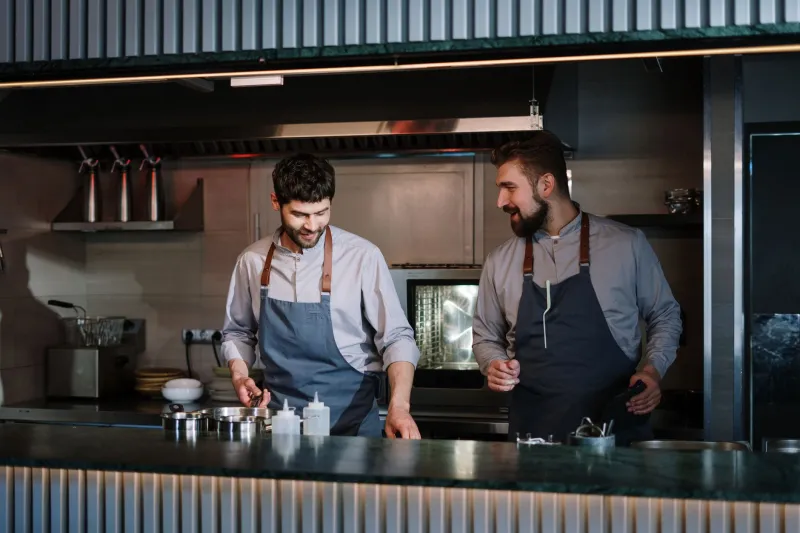
The term 'flat structure' is sometimes misunderstood to imply an absence of expertise or leadership. In practice, the most effective collaborative kitchen models maintain clear lines of culinary responsibility whilst dismantling the rigid status distinctions that characterise traditional brigade environments.
In a flat kitchen, sections are frequently rotated rather than permanently assigned, enabling every member of the team to develop competence across multiple areas of production. Decision-making around menu development is distributed rather than concentrated: junior chefs contribute ideas that are genuinely considered, and the process of refining a dish becomes a collective exercise rather than the exclusive province of a head chef's vision.
Leadership in these environments tends to be situational. During service, the most experienced professional present will naturally direct the flow of the kitchen, but that authority derives from demonstrated skill and contextual knowledge rather than from a fixed hierarchical position. Between services, the dynamic is considerably more egalitarian.
Several independent restaurants operating under this model in London, Leeds, and Glasgow have dispensed with traditional job titles entirely, preferring functional descriptions that emphasise the work rather than the rank. The practical effect is a reduction in the status anxiety that can make traditional brigade environments psychologically draining for professionals at every level, not only those at the bottom of the hierarchy.
Career Development Under a Collaborative Model
For professionals accustomed to the traditional brigade pathway — commis to chef de partie to sous chef, each stage gated by time served and the discretion of a senior chef — the flat kitchen presents both opportunity and uncertainty.
The opportunity is substantial. In a kitchen where section rotation is standard practice, a professional with two years of experience may develop a breadth of technical competence that a brigade counterpart with the same tenure, permanently stationed on a single section, simply cannot match. That breadth has demonstrable value in the employment market: chefs who can speak credibly about multiple areas of kitchen production are considerably more attractive to operators than those with deep but narrow expertise.
The uncertainty relates to progression. In a flat structure, the traditional milestones that signal advancement — promotion to chef de partie, appointment as sous chef — may be less clearly defined. Professionals working within these models benefit from establishing explicit conversations with their employers about how development is recognised and rewarded, and from seeking regular, structured feedback in the absence of formal appraisal processes that brigade hierarchies tend to generate automatically.
For chefs who have worked under both systems, the contrast is frequently described in terms of psychological experience as much as technical development. The relief of working in an environment where questions are welcomed rather than treated as evidence of incompetence, and where mistakes are addressed as learning opportunities rather than occasions for public humiliation, is cited consistently as a factor in both performance and retention.
Does Collaboration Produce Better Food?
This is the question that cuts to the heart of the debate, and the honest answer is that the evidence is nuanced.
There is a credible argument that the finest culinary output requires a singular, coherent vision — that the greatest restaurant experiences in the world are expressions of an individual chef's aesthetic intelligence rather than the product of committee deliberation. The brigade system, for all its rigidities, creates the conditions in which that singular vision can be executed consistently at scale.
There is an equally credible argument, however, that the best ideas in any creative environment emerge from diverse perspectives in genuine dialogue, and that a kitchen culture in which junior professionals feel safe to contribute is one that generates more interesting, more inventive food than one in which creativity is the exclusive domain of those at the top of the hierarchy.
The practical reality is that the most successful flat kitchens in Britain are not leaderless. They are led by chefs who have developed the interpersonal skill and intellectual confidence to invite collaboration without abdicating creative direction. That combination — culinary authority exercised through inclusion rather than command — is considerably rarer and considerably more difficult to develop than the traditional model requires.
The Retention Argument
Whatever the culinary debate, the operational case for collaborative kitchen cultures is becoming increasingly difficult to dismiss. Staff turnover in UK hospitality kitchens remains a persistent and expensive problem. The physical and psychological demands of traditional brigade environments — the long hours, the hierarchical pressure, the limited scope for individual agency — are frequently identified by departing chefs as significant factors in their decision to leave.
Operators who have adopted flatter structures report meaningfully lower attrition rates, though the picture is complicated by the fact that these tend to be venues that have also invested in other aspects of their employment proposition, including scheduling, pay transparency, and workplace wellbeing. Disentangling the specific contribution of kitchen structure to retention outcomes is methodologically difficult.
What is clear is that the pipeline of talent entering professional kitchens has changed. A new generation of culinary professionals, many of whom have trained in environments that emphasise collaborative learning and psychological safety, are actively seeking workplaces that reflect those values. For operators who continue to rely on traditional brigade authority as their primary management tool, the competition for that talent is becoming more challenging with each passing year.
The brigade system served the industry well for a century. Whether it remains the optimal framework for the century ahead is a question that Britain's most thoughtful operators are already answering — quietly, and with considerable conviction.