Smart Casual Is Not Neutral: Rethinking Uniform and Grooming Rules in UK Hospitality
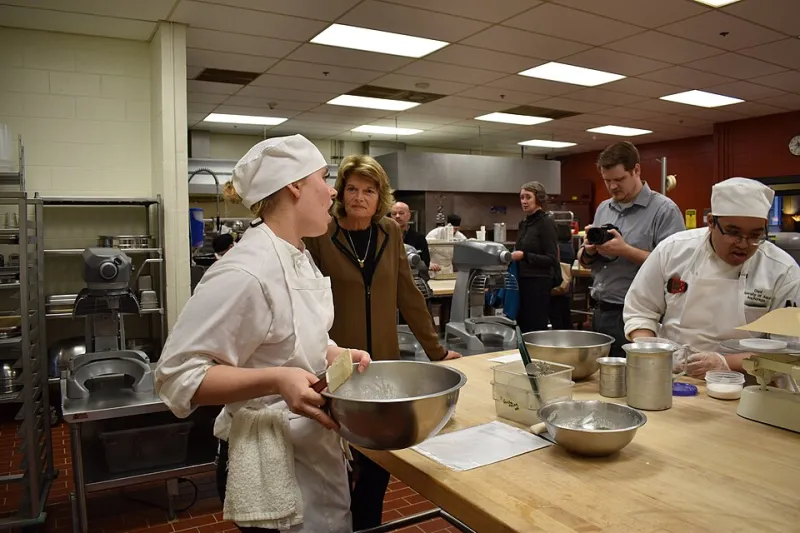
Photo: United States Senate - Office of Lisa Murkowski, Public domain, via Wikimedia Commons
There is a particular sentence that appears in almost every British hospitality job advert and explains almost nothing: 'smart casual, with a professional appearance'. It is a rule that pretends not to be one. And because it is never defined, it is enforced by whoever happens to be managing that day, against whoever happens to be standing in front of them.
The instruction that explains nothing
'Smart casual' is a mood, not a standard. In practice it means that a 19-year-old with a nose piercing and a 45-year-old with a wedding ring are judged by different eyes. It means that a woman is quietly expected to wear makeup and a man is not. It means that a Black member of staff with braided hair is asked whether it is 'tidy', while a colleague with a ponytail is not asked anything at all.
A uniform policy that cannot be written down precisely is not a policy. It is a set of preferences, and preferences fall unevenly.
Uniforms are an argument about who belongs
We tend to talk about uniforms as branding: the colour, the cut, the logo. But a uniform is also a statement about the kind of person the venue imagines when it pictures its team. When the stock shirts only go up to a certain size, or the trousers are cut for one body shape, the message is not subtle. When the only available style is a fitted dress, half the team is being told something about the role they are expected to play.
And it is never only about appearance. In venues where the uniform is supplied, the staff who fit the sample size look polished in photographs and are the ones chosen for the events, the press dinner, the wine tasting. That visibility is the raw material of promotion.
The gendered seam
UK law does not forbid separate dress requirements for men and women, but the Equality Act 2010 does require that they are comparable in burden. A code that requires women to wear heels and men to wear flat shoes is difficult to defend. So is one that requires makeup of women and not of men, or that allows men to have short hair but disciplines women for the same cut.
Religious and cultural requirements need particular care: head coverings, turbans, kara, religious jewellery near food. Health and safety is a legitimate reason to ask for a change — hair tied back in a kitchen is a food hygiene matter, not a personal preference — but the justification should be specific and applied to everyone doing the same task.
Hair, tattoos and the cost of conformity
Hairstyles are where dress codes most often slip into something more troubling. Afro-textured hair has historically been judged against standards built for other hair types, and policies that ban braids, locs or twists without any safety rationale have a disparate impact. Frameworks such as the Halo Code offer employers a simple way to write a policy that does not require anyone to chemically straighten their hair.
Tattoos are another fault line. In 2026, a visible tattoo on a forearm says very little about a person's ability to run a section or remember an allergy. Where a venue bans them, it should be able to say why — and 'the guests might not like it' is a claim that deserves testing rather than assuming.
There is also the matter of cost. Where staff buy their own uniform, the burden falls hardest on the lowest-paid. Shoes that meet a venue's standard, laundry, replacements after a bleach spill — these are real deductions from a real wage.
A fairer framework: five tests
A venue reviewing its dress code could do worse than run it through five questions.
Purpose. Is the rule there for safety, hygiene, or clear identification — or simply for taste?
Consistency. Does it apply to everyone doing the same job, and does it treat men and women comparably?
Cost. Who pays, and does the requirement fall disproportionately on the lowest-paid staff?
Expression. Does the rule suppress a characteristic protected under the Equality Act 2010, or a cultural practice, without justification?
Review. When was this policy last looked at, and who was consulted?
A policy that survives all five is likely to be defensible. One that fails two or three is a policy waiting for a grievance.
Who is in the room
None of this means abandoning standards. A professional appearance still matters in a sector built on hospitality. But professionalism is not a haircut. It is whether someone turns up on time, knows the menu, handles a complaint well, and makes a guest feel looked after.
The test of a uniform policy is not whether it produces a photograph the marketing team likes. It is whether it lets every member of staff do their job with dignity, and whether the people writing the rules have asked the people wearing them what they think. Smart casual is not neutral. It is time to say what we actually mean.